



Accounting
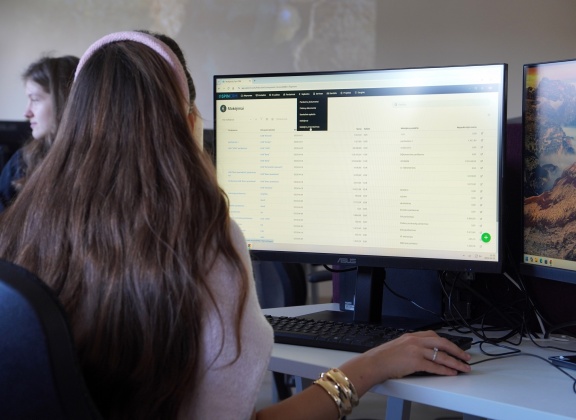
A professional accountant who oversees company's entire accounting system, prepares reports and budgets, calculates and files taxes relies on industry-standard accounting software, personal diligence, responsibility, logical thinking, mathematical aptitude, and professional accounting education to fulfill these responsibilities effectively.
It is an open secret that the Accounting study programme at Šiaulių valstybinė kolegija is distinguished by particularly good employment possibilities – more than 80 percent of graduates get easily employed in business companies or the public sector immediately after the graduation. And it could be you!
Studies at Šiaulių valstybinė kolegija can be combined with work – both in full-time and part-time mode. Individual needs are acommodated on a case-by-case basis.
We consult entrants by phone +370 615 97 114, e-mail priemimas@svako.lt or at the central building of the ŠVK (Aušros al. 40, room 211, Šiauliai).
Further possible career paths
| Access to professional activity | The graduate will be able to work in the accounting departments or services of companies, organizations, establish a service company providing accounting services and provide accounting management services, work as accountants |
| Access to further study | Studies can be continued at universities in the programmes of Business and Public Administration group of study fields and Economics field. |
Study programme information
| Mode and duration | Full-time – 3 years, Part-time – 4 years |
| Study Programme national code | 6531LX079 |
| Scope of the study | 180 credits (ECTS) |
| Language of instruction | Lithuanian |
| Field of education | Business and Administration |
| Group of study fields | Social Sciences |
| Study field | Accounting |
| Qualification degree and (or) qualification to be awarded | Professional Bachelor of Business Management |
| Chairman of the Study Programme Committee | Business and Accounting Department professor dr. Rita Bužinskienė, email r.buzinskiene@svako.lt |
| The head of the department | The Head of Business and Accounting Department lecturer dr. Renata Šivickienė, email r.sivickiene@svako.lt, tel. +370 41 52 50 51 |
Objectives of a study programme and intended learning outcomes
Objective(s) of a study programme – to prepare specialists for organizations operating in the country and on the international market, capable of managing financial accounting, controlling the accounting of economic processes, preparing financial reports, performing analysis of financial status and performance, and participating in the preparation of organizational budgets, carrying out various project-based, creativity- and self-expression-based activities, constantly learning by evaluating challenges of the changing environment
Learning outcomes
| After successful completion of the study programme, a student: | |
| Knowledge and its application | – He/she knows general principles of the economics, management, finance and accounting sciences, fundamental theories, enabling to understand internal and external environmental factors of organizations and their accounting, management and assessment methods and is able to apply them in practical accounting activities. – He/she understands the accounting functions of the public and private sector, is able to apply knowledge of professional activity, accounting methods, solving specific problems in the fields of accounting, taxes, auditing at the organizational level. – He/she knows and relies on legal acts regulating accounting and auditing procedures, principles of accounting and financial control. |
| Research skills | – He/she is able to conduct research, collect and analyze data necessary for decision-making by organizations or users of financial information, using modern information technologies and applying effective research methods and models. |
| Special skills | – He/she is able to use information technologies, special computer accounting software and process accounting information using them. – He/she applies accounting and tax legislation, international financial accountability and national financial accountability standards. – He/she understands the principles and aims of the procedure for registering and evaluating economic transactions, implements it and controls its legitimacy. – He/she manages the accounting of organizations and natural persons independently: formalizes economic transactions, accounts for long-term and short-term assets, equity, accounts payable and liabilities, income and costs, prepares a set of financial statements, statistical reporting, declares taxes. – He/she summarises, analyses, systematises the data of the organization's financial reports, evaluates the financial condition and performance results, cash flows, makes proposals for management, financing, and investment decisions. – He/she participates in preparing (prepares) the organization's budget, business plan, project, justifies the efficiency of resource utilization, applies the internal control system, assesses financial risks. – He/she is able to perform practical accounting activities, plans, organizes, controls the activities of the accounting department, independently choosing technological, organizational and methodological tools. |
| Social skills | – He/she is able to communicate effectively in the national language and at least one foreign language, convey knowledge and understanding, following professional ethics and citizenship, critically and consistently express ideas, raise accounting problems and solve them. |
| Personal skills | – He/she is able to self-develop in areas of professional activity, expands professional competence, is interested in innovations in accounting science, perceives responsibility for the impact of their activity results on public welfare and environment. – He/she is able to perform various activities based on creativity and self-expression in a changing and international environment. |
Study subjects (modules) and practical training
| YEAR I | YEAR II | YEAR III |
|---|---|---|
| Semester I | Semester III | Semester V |
|
|
|
| Semester II | Semester IV | Semester VI |
|
|
|
|